
Navigating the Alphabet Soup: A Parent’s Guide to Boys’ Youth Soccer Leagues
Choosing the right soccer environment for your son can feel like navigating a maze of conflicting advice, regional differences, and an exhausting "alphabet soup" of league acronyms. You’ll hear other parents whispering about ECNL, bragging about MLS NEXT, or contentedly discussing their local recreational league. But what do these letters actually mean for your child?
This guide is designed to demystify the landscape of American boys' youth soccer, helping you understand where your son fits now, where he might go in the future, and how to make the best decision for his happiness and development.
Understanding the "Why" Before the "What"
Before diving into specific leagues, it’s crucial to understand that there is no single "best" league. The best league for your son is the one that matches his current skill level, commitment, and goals. A talented player who loves soccer but wants to play other sports or focus heavily on academics may be miserable (and burn out) in a top-tier national league.
Conversely, a player who dreams of playing professionally will need the exposure and training found only at the top of the pyramid.
The U.S. Boys’ Soccer Pyramid: The Hierarchy Explained
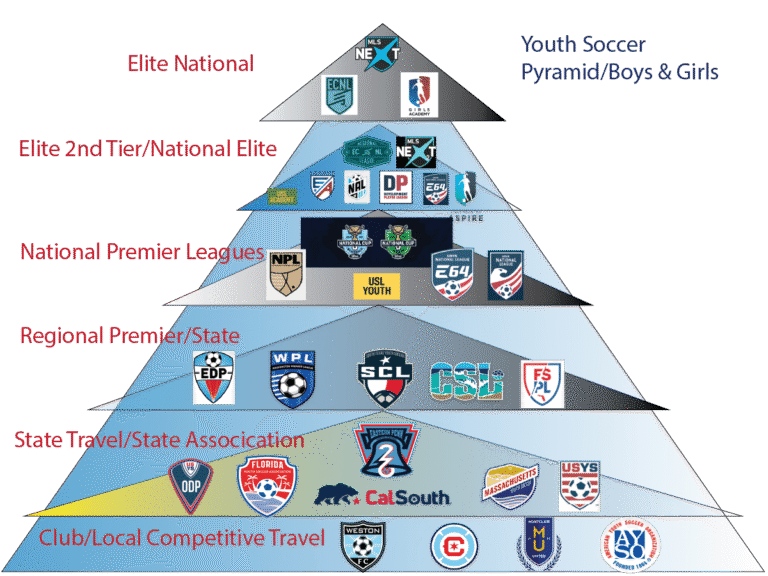
To visualize how these leagues relate to one another, think of them as a pyramid. The base is the widest, with the most players and the lowest commitment/cost. As you move up, the number of players decreases, the competition increases, and the demands on your time and wallet grow significantly.
Here is a breakdown of the pyramid for boys' youth soccer as it stands today.

DISCLAIMER: This chart provides a general overview of U.S. youth soccer leagues. Pathways, league names, and levels vary by state, club, and gender. It is not comprehensive; some leagues may be missing, and logos are examples, not endorsements. The pyramid reflects recognized pathways as of 2025, but not all local options are included. League structures may differ by region, gender, and age, and can change. For personalized guidance, families should contact local clubs or league resources.
Detailed Breakdown of Key League Types
1. The Elite Tiers (MLS NEXT & ECNL Boys)
These are the highest levels of youth soccer available in the U.S. They are designed for elite players seeking maximum exposure to college coaches and professional scouts.
- MLS NEXT:
- What it is: The top league for boys in North America, launched by Major League Soccer in 2020. It includes all official MLS academies (which are typically free to players) and top-tier non-MLS independent clubs.
- Focus: Strictly controlled training environments, professional coaching standards, and the most direct pathway to professional soccer (including MLS NEXT Pro and first teams).
- Parental Considerations: Very high cost (if not at an MLS-funded academy), extreme time commitment (4+ days a week), significant travel across the country for league games and showcases.
- ECNL Boys (Elite Clubs National League):
- What it is: A club-driven national league that was historically dominant on the girls' side but has become exceptionally strong on the boys' side.
- Focus: Highly competitive regional conferences leading to national championships. It is widely considered the premier league for college recruitment exposure on the boys' side.
- Parental Considerations: Very high cost, heavy time commitment (3-4 days a week), significant regional and national travel for games and showcases.
2. The Regional Elite Tier (NPL, USYS National League)
These leagues offer excellent competition, professional coaching, and strong paths to college soccer, but often with less travel or cost than the national elite tiers.
- NPL (National Premier Leagues):
- What it is: A collection of regional leagues under the US Club Soccer umbrella. Clubs must qualify to participate.
- Focus: Providing high-level, consistent competition within a manageable geographic area, leading to national finals.
- Parental Considerations: Moderate to high cost, moderate to heavy travel (mostly regional driving), strong coaching.
- USYS National League (U.S. Youth Soccer):
- What it is: A league structure operated by the largest youth soccer organization in the country, connecting state-level winners to national playoffs.
- Focus: A team-based qualification system where teams must earn their spot through performance in state and regional conferences.
- Parental Considerations: Similar to NPL; strong competition, but often requires winning a state cup or premier league division to enter the top tiers of the National League.
3. The Travel/Competitive Tier (State & Local Premier Leagues)
This is where the majority of competitive youth players spend their time. These leagues are sanctioned by state associations and offer structured play.
- What they are: Leagues like EDP (Elite Development Program) or state-specific Premier I/II divisions.
- Focus: Organized competitive play against other local/regional clubs. Travel is usually limited to 1-2 hours for away games.
- Parental Considerations: Moderate cost, manageable travel, highly variable coaching quality.
4. The Developmental/Recreational Tiers (Rec & Local Academies)
This is the starting point for most players.
- What they are: Town leagues, AYSO, or "Pre-Academy" programs within larger clubs.
- Focus: Fun, basic skill acquisition, and falling in love with the game. Everyone usually plays equal time.
- Parental Considerations: Low cost, very low time commitment, volunteer coaches.
How Parents Should Choose
When a club asks your son to try out for a "higher" team or league, use these questions to guide your family’s decision:
- What are his goals? Does he really want to chase a college or professional dream, or does he want to play with his friends and enjoy other activities?
- What is the realistic commitment? Ask the club for the exact schedule: how many practices per week, how many weekend games, how many overnight tournaments, and how many plane trips for showcases?
- What is the total cost? Don't just look at the club fee. Factor in uniforms, team fees, and the massive costs of travel (gas, hotels, food, flights). Top leagues can easily cost $5,000–$10,000+ per year.
- What is the coaching quality? A patch on a jersey doesn't guarantee good coaching. Who will actually be teaching your son, and what is their philosophy?
- Is he happy? Most importantly, does he enjoy the environment, his teammates, and the level of pressure? A happier player always develops faster than a miserable one.
Recent Posts